
What makes a reliable linen clothing manufacturer different from traders?
What Makes a Reliable Linen Clothing Manufacturer Different from Traders?
A reliable linen clothing manufacturer directly owns and controls production processes—such as fabric sourcing, sampling, cutting, sewing, washing, and quality control—while traders act as intermediaries who outsource production and do not manage manufacturing firsthand.
This direct control makes manufacturers more reliable in quality consistency, lead time, customization, and accountability.
Core Differences Between Linen Clothing Manufacturers and Traders
1. Direct Production Control vs. Outsourcing
Reliable linen clothing manufacturers operate their own factories or dedicated production lines, whereas traders rely on third-party factories.
Manufacturers typically control:
Linen fabric sourcing and testing
Pattern making and sampling
Cutting, sewing, and finishing
Washing and shrinkage control
In-house quality inspections
Traders usually:
Place orders with multiple factories
Have limited visibility into real production
Cannot guarantee consistent processes
2. Linen-Specific Technical Expertise
Linen is a natural fiber with unique challenges:
Shrinkage after washing
Lower elasticity
Fiber slubs and texture variation
A reliable linen clothing manufacturer has hands-on technical expertise in linen fabrics, while traders typically lack fabric-level knowledge and rely on factory feedback.
This expertise directly impacts:
Fit accuracy
Wash stability
Garment durability
3. OEM & ODM Development Capability
Manufacturers usually provide:
OEM production from tech packs
ODM design and pattern development
Fabric and trim recommendations
Sampling and revisions
Traders often:
Cannot modify patterns directly
Depend on factory schedules for samples
Offer limited development support
For brands developing new linen products, manufacturers offer far greater flexibility.
4. Quality Control Responsibility
Reliable linen clothing manufacturers take full responsibility for quality control at every stage of production, while traders often only inspect finished goods.
Manufacturer QC includes:
Fabric inspection before cutting
Inline sewing inspections
Post-wash measurement checks
Final AQL inspection
Traders may only conduct:
Visual checks at shipment stage
This difference greatly affects consistency and defect rates.
5. Transparency & Accountability
Manufacturers provide:
Factory access or audits
Clear production timelines
Real-time updates during production
Direct communication with technical teams
Traders often:
Act as a communication buffer
Cannot guarantee factory schedules
Have limited authority over production issues
Direct accountability reduces risk for brands.
6. Cost Structure & Long-Term Value
While traders may appear cheaper initially, manufacturers often provide better long-term value through stable pricing, fewer errors, and reduced rework.
Manufacturers:
Eliminate middle-man markups
Offer more stable repeat pricing
Reduce costs from quality issues
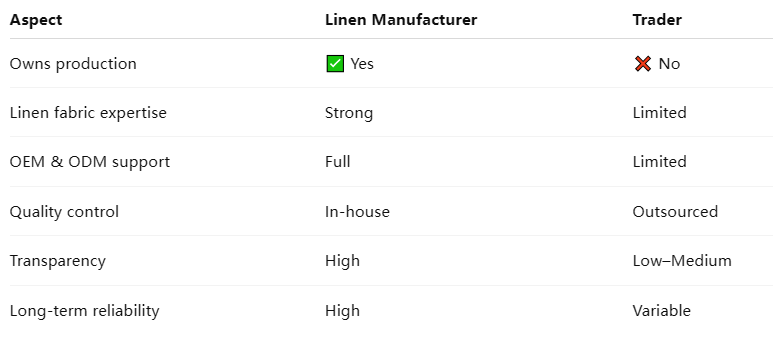
Comparison Table: Manufacturer vs. Trader
Linenwind as a Direct Linen Clothing Manufacturer
At Linenwind, we are a direct linen clothing manufacturer—not a trader—offering full in-house OEM & ODM services with direct control over quality, timelines, and production processes.
Our strengths include:
🌿 Eco-friendly linen and sustainable production
⚙ In-house design, sampling, and manufacturing
🛎 Low MOQ of 60 pieces
🔍 Rigorous quality assurance with real-time communication
🤝 Dedicated account managers
🧵 20 years of apparel manufacturing experience
👉 Learn more about our manufacturing services:Linen clothing OEM ODM
When a Trader Might Be Acceptable—and When Not
Traders May Be Acceptable If:
You need generic products quickly
Customization is minimal
Long-term consistency is not critical
Manufacturers Are Better If:
You need custom linen products
Quality and fit matter
You plan repeat or long-term orders
Brand reputation is a priority
Final Takeaway
A reliable linen clothing manufacturer differs from traders by directly controlling production, possessing linen-specific technical expertise, managing in-house quality control, and offering greater transparency and accountability—making manufacturers a safer choice for long-term brand partnerships.
👉 Contact us to work directly with a linen clothing manufacturer: